Cost of Athletic Track Construction in India: What You Need to Know Before You Build
Athletic Track Dimensions: 400m Standard Track Size, Lanes and Markings

A standard outdoor running track is 400 metres around, built as two parallel straights joined by two semicircular bends. These athletics track dimensions come from World Athletics rules, and they are the basis for almost every school, university and stadium track in India. This guide covers lane widths, radii, stagger, field event zones, smaller track formats and the land you need.
If you are planning a new track, our athletic track construction service covers design, base engineering and surfacing end to end.
What a standard 400m track looks like
A 400m standard track is a stadium-shaped oval with two equal straights and two equal bends. Lane 1 measures exactly 400 m along a line 0.30 m outside the inner kerb. Athletes run anticlockwise, with the infield on their left.
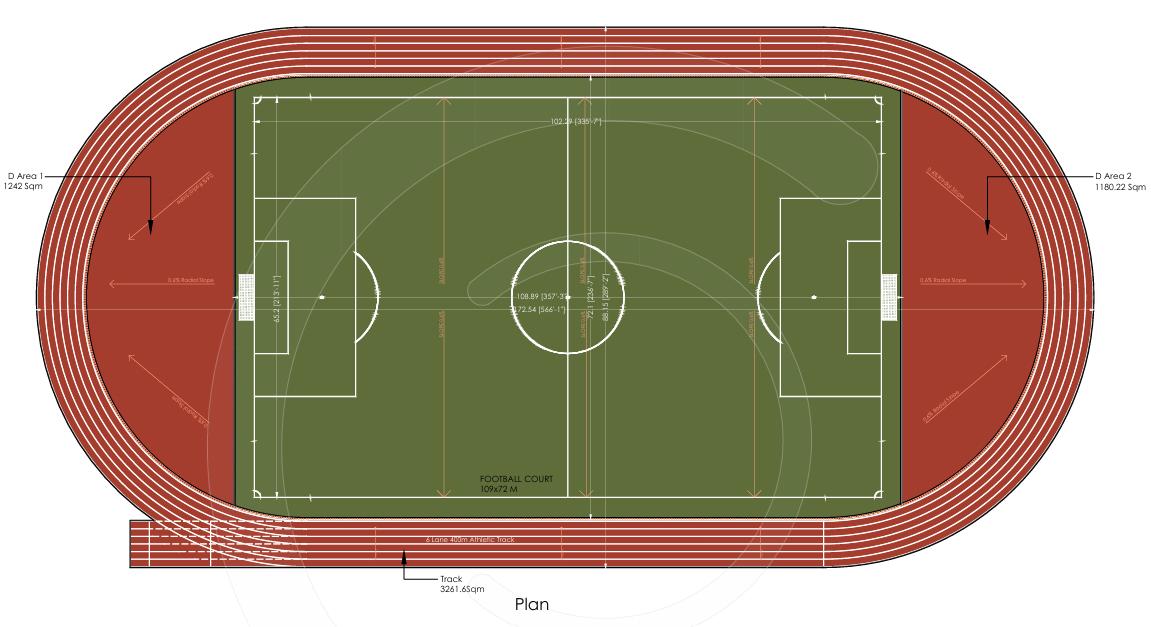
An athletic track diagram shows this in plan view: the oval, numbered lanes, the finish line at the end of the home straight, staggered start lines and the infield. The key figures for an eight-lane layout are below.
Measurement | Value |
|---|---|
Lap length (lane 1) | 440 m |
Straight length | 84.39 m |
Inner radius (to kerb edge) | 36.50m |
Radius of lane 1 measuring line | 36.80m |
Lane width | 1.22 m |
Lane line width | 5 cm |
Eight lanes combined | 9.76 m |
Overall outer size (8 lanes) | approx. 177 m × 92.5 m |
Infield inside the kerb | approx. 157.39 m × 73 m |
Lane width, lane count and stagger explained
Every lane is 1.22 m wide, including the 5 cm white line on its right-hand side. A competition track normally has eight lanes, some major venues use nine, and many schools build six to save land. The lane count is the biggest lever on land take and cost.
Outer lanes run a larger circle round the bends, so they start further ahead. This is the stagger. The table shows what that means over one lap, calculated from the geometry above and rounded. After lane 2, each lane adds about 7.7 m. The painted start lines compensate for this difference, and the final stagger positions come from the marking plan your surveyor sets out. A small setting-out error carries into every race on the track.
Inner radius, straights and bends
The inner radius of a standard track is 36.50 m, measured to the edge of the kerb. Because lane 1 is measured 0.30 m out, the running line has a radius of 36.80 m. Each bend is a half circle of that radius, about 115.61 m long, and each straight is 84.39 m. Two straights plus two bends add up to 400 m.
The raised kerb marks the inside of lane 1 and keeps athletes on the track. The surface also needs a slight fall for drainage. World Athletics limits the slope to about 1:100 across the track, towards the infield, and 1:1000 along the running direction. Water must leave the track quickly, but the surface must still feel level to runners.
For Indian sites, World Athletics also advises aligning the straights roughly north–south where possible. That keeps low morning and evening sun out of athletes' eyes.
Field event zones inside the track (long jump, shot put, javelin)
The infield and the areas around the straights host the field events. Each event has its own runway or circle, landing zone and safety margin. The most common figures are below.
| Event | Key Dimensions | Usual Positions |
|---|---|---|
| Long Jump | Runway 1.22 m wide, at least 40 m long (45 m preferred); landing pit 2.75–3.00 m wide | Alongside a straight, outside or inside the track |
| Shot Put | Circle 2.135 m diameter; landing sector 34.92° | Infield or a dedicated throws area |
| Javelin | Runway 4 m wide, at least 30 m long (33.5 m preferred); 8 m arc; sector 28.96° | Infield, usually at one end |
Throwing events need the most planning. Javelin and shot landing sectors reach far across the infield, so they conflict with football if both run at once. Schools often schedule them separately, or build the throws area outside the oval. Discus and hammer need a protective cage, so decide early whether you will offer them.
A 400m track and a football pitch are a popular pairing. A full-size pitch such as 105 m × 68 m generally fits in the 157 m × 73 m infield, but confirm with your designer.
200m, 300m and school-size tracks: what changes
A smaller track changes the lap length, the bend radius, the straight length and the lane count. Most things you may want from a track then change too: race distances no longer divide cleanly into laps, and results on a non-standard track cannot be certified for records.
| Format | What Changes | Best for |
|---|---|---|
| 400m, 8 lanes | Full World Athletics geometry | Certified and district/state events |
| 400m, 6 lanes | Same oval, narrower total width (approx. 172 m × 88 m overall) | Schools, colleges, clubs |
| 300m outdoor | Non-standard oval; no fixed international layout, so the radius and straights are set by your designer | Training in tighter campuses |
| 200m indoor | Tighter bends, usually banked, narrower lanes | Indoor halls and indoor championships |
A shorter oval has tighter bends, which makes the stagger and the effort of running the bend different. A 100 m sprint also needs a straight of at least 100 m plus a run-out, so very small ovals may not host it. If you want competition results to count, build the full 400m layout, even with six lanes. For smaller campuses, a custom oval or a straight sprint strip can serve training well.
Space needed for a 400m track in India
An eight-lane 400m track needs roughly 177 m × 93 m for the track alone, or about 1.6 hectares (around 4 acres). A six-lane track needs about 172 m × 88 m. Add run-offs, safety margins for field events, walkways and any seating, so plan for more than the bare oval.
Indian conditions add their own checks:
Monsoon drainage: a drain around the inner kerb and a well-compacted base that sheds water fast.
Soil: weak or clayey ground needs extra groundwork before surfacing.
Heat: surface choice affects comfort in summer, so discuss it early.
Orientation: a north–south straight axis is preferred, as noted above.
Upkeep: budget for regular cleaning and line repainting.
FAQ:
- What are the standard athletics track dimensions?
A standard track is 400 m around, with two straights of 84.39 m and bends of 36.50 m inner radius. Lanes are 1.22 m wide, and eight lanes are standard. - Which direction do athletes run on a track?
Anticlockwise, with the infield on their left. - How many lanes should a school track have?
Six lanes are common for training and sports days. Choose eight if you want to host district or state events. - Can a football pitch fit inside a 400m track?
Usually, yes. The infield is about 157 m × 73 m, which generally takes a full-size pitch. Confirm the exact fit and the throwing zones with your designer.
Plan your track with Michezo Sports
Getting the athletics track dimensions right at the start avoids costly rework. Michezo Sports can help with layout, base engineering, drainage and surfacing for schools, clubs and developers across India. Contact us for a free consultation.